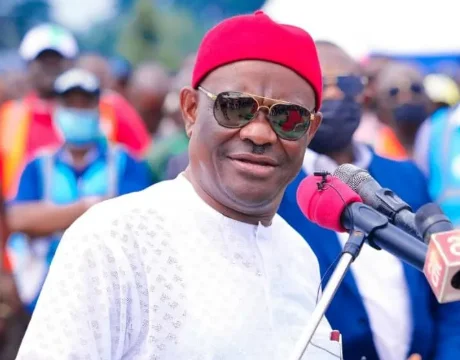
Nyesom Wike’s record in public office is built around visible projects: first as a two-term governor of Rivers State, and since August 2023 as Minister of the Federal Capital Territory (FCT). This post covers the programs and projects from both roles that have supported businesses, workers, students and families, and says where each claim comes from. Many figures come from the FCT Administration itself, so they are the government’s account rather than independent audits.
Rivers State: roads, flyovers and institutions
Wike’s most recognisable Port Harcourt legacy is a run of 12 flyovers built between 2019 and 2023, which he said were sited to decongest the state capital. Julius Berger said work began in October 2019, and the president of the engineering regulator COREN later visited to study the state’s engineering record. Beyond traffic, his administration also worked on:
- Rural roads. The 16-km dual-carriageway Saakpenwa–Bori road into Ogoniland was commissioned, with a second phase to Kono announced. The 13.6-km Trans-Kalabari road to island communities was flagged off in June 2021, but was still under construction in late 2025. A Tide newspaper editorial argued these roads would help farmers move produce to market.
- Legal education. The state built the Nabo Graham Douglas campus of the Nigerian Law School in Port Harcourt and handed it over about a year after construction began; the school’s director-general called it the best law campus in the country. The state also funded a 900-bed hostel and a 1,500-capacity auditorium at the Yenagoa campus.
- Sport and health. Rivers partnered with the Real Madrid Foundation on a football academy in Port Harcourt, which Wike framed as a way to empower youths and grow the economy. A Mother and Child Hospital was also due to open, with plans to hand management to a private operator.
- Investment and industry. Wike pitched Rivers to investors at a Financial Times event in London in 2018, toured the INTELS Oil and Gas Free Zone in Onne, and commissioned Alcon Nigeria’s low-voltage panel assembly plant in Port Harcourt. He also pledged to turn Trans-Amadi into an economic zone to draw manufacturers back.
Abuja: completing what others left unfinished
Wike says about 70% of the infrastructure his administration has completed in the FCT was made up of contracts abandoned for 15 to 16 years. The main results he and officials point to:
- City roads. In the first nine months after his August 2023 appointment, the administration completed the Wuye–Wuse I interchange bridge, resurfaced 189 roads covering 57 km, and built an 11-km access road to Kuje.
- Satellite towns. Wike says 221 km of roads were completed in satellite towns in three years, with another 96 km under way. Residents describe the 15-km dualised Karu road as a major intervention on a key gateway into Abuja.
- Markets and traders. The administration has opened district markets, including one in Karmo, where officials say shops are priced below other markets with flexible payment plans. A new international market with about 5,312 shops is meant to move roadside traders into a proper trading space.
- Revenue and doing business. Wike says monthly internally generated revenue rose from about ₦9 billion to over ₦40 billion in three years, which he credits to plugging leakages and land-related payments. He also signed about 7,000 Certificates of Occupancy, arguing that titled land helps owners grow their businesses.
- What is next. In July 2026 he said eight to 10 more projects would be inaugurated before December, with others targeted for December 2026 and January 2027. These are targets, and delivery had not been confirmed at the time of writing.
Investing in people: scholarships, schools, health and skills
The FCT Administration has paired its road building with programs aimed directly at residents.
- Scholarships. Wike approved ₦280.3 million for 13,946 indigent students in March 2024 and ₦300 million for 16,225 students in 2025. The scholarship board says it has supported 146,000 students since 2020, including students with special needs who receive wheelchairs and learning materials, and that funds go straight into beneficiaries’ bank accounts.
- Schools. The administration flagged off the rehabilitation of 19 public schools and announced 20 more. An education official says it has invested more than ₦230 billion in school facilities, and Wike approved teacher training and vocational skills training for youths, women and out-of-school children.
- Health. In September 2026 he approved the completion of the abandoned Utako General Hospital and the upgrade of all 14 general hospitals. Officials say 86 primary health centres have been upgraded, that primary centres now run 24 hours and oxygen plants were installed at four hospitals, and that 200 more health workers are to be recruited.
- Skills and youth. Wike opened a five-day ICT training for 300 youths, selected from about 500 registrants. The FCT education secretariat says it has concluded plans for vocational knowledge centres in all six area councils.
A balanced note
Most figures above are reported by the FCT Administration, the Rivers State government or government-owned outlets, so they are claims to verify, not audited results. Several points have drawn criticism:
- Cost transparency. A rights group, the Rivers Anti-corruption Network, sued the Rivers government over cost disclosure for recently awarded projects.
- Economic payoff. Some observers saw the Rivers flyovers and similar works as signature projects with no direct economic bearing on residents, while Wike called them legacy projects.
- Traders’ costs. Wuse Market traders petitioned Wike over shop prices they called unaffordable.
- Politics and borrowing. Wike has defended FCT borrowing as a question of how funds are used, and defended project inspections as showcasing achievements ahead of the 2027 elections.
Conclusion
Across both offices, Wike’s pattern is fast, visible capital works, backed by smaller programs that reach individuals: scholarships, clinics, training and trading space. Whether the economic returns match the spending will take years of independent data to show. For now, the clearest evidence is in what commuters, traders and students in Port Harcourt and Abuja can see and use, and in the next round of FCT projects due by January 2027.