
Nigeria’s maritime waters, once closely associated with piracy incidents in the Gulf of Guinea, have recorded four consecutive years without any reported attack, according to the Nigerian Maritime Administration and Safety Agency (NIMASA).
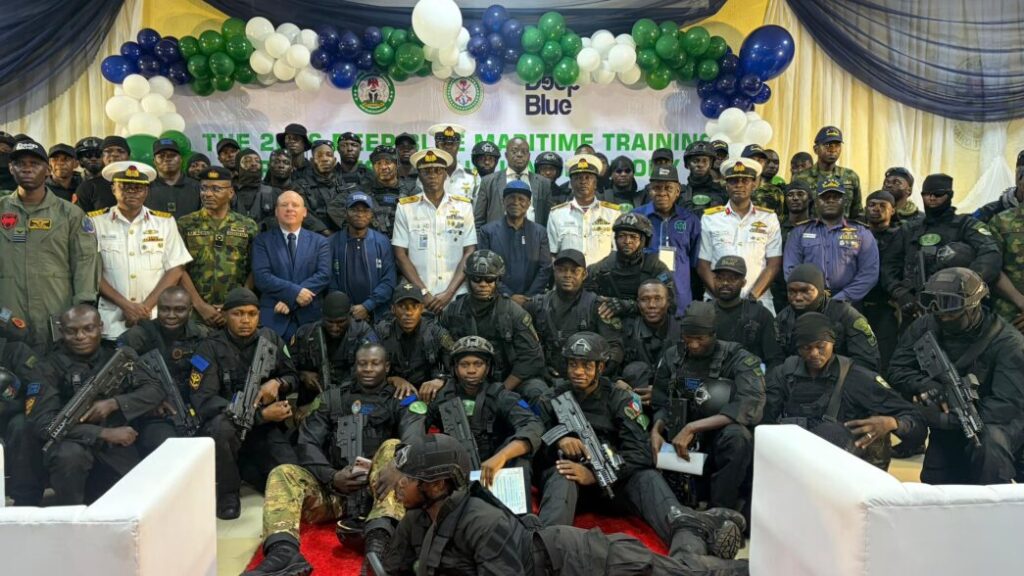
The agency’s director-general, Dayo Mobereola, made the disclosure in Lagos during a Command, Control, Communication, Computer and Intelligence capability demonstration and graduation ceremony for maritime security personnel under the Deep Blue Project. He said the improvement reflects sustained investment in surveillance systems, inter-agency coordination, and operational readiness across Nigeria’s coastal and offshore environment.
The event also marked the graduation of 177 personnel trained across different maritime security specialties, including special mission vessel operations, fast intervention boat handling, helicopter support missions, and tactical response coordination.
Training modules reportedly covered emergency evacuation, boarding operations, communications systems, unmanned aerial surveillance, and combat medical response, designed to strengthen rapid intervention capacity on waterways. Mobereola said the combined effect of these systems has contributed to restoring confidence in Nigeria’s maritime domain and reducing insurance risks linked to regional shipping routes.
“For four years now, Nigeria has maintained an impressive record of zero incidence of piracy attacks,” he said during the ceremony. The announcement comes at a time when Nigeria has been trying to reposition its maritime sector as part of broader economic diversification efforts under the blue economy agenda.
Security operations under the Deep Blue Project have been central to that push, involving naval forces, air surveillance units, and intelligence coordination platforms designed to monitor both coastal and offshore activity.
Officials say the system integrates patrol vessels, aircraft, and rapid response teams to respond to threats before they escalate into full-scale maritime attacks. Attention has also shifted to international perception, with Nigeria previously listed among high-risk maritime zones in global shipping advisories. The absence of reported attacks over a sustained period is now being used by officials as evidence of progress in changing that narrative.
Still, the claim of zero piracy incidents over multiple years is likely to draw scrutiny from maritime analysts who often rely on broader international reporting systems and independent verification across Gulf of Guinea waters.
Security experts have previously noted that maritime crime reporting can vary depending on classification, coverage zones, and jurisdictional definitions of piracy versus armed robbery at sea.
For coastal communities and shipping operators, however, the more immediate concern remains consistency. A long stretch of calm waters is often seen as positive, but maintaining it has historically required constant surveillance and rapid response capability.
Nigeria’s push for improved maritime safety also ties into economic objectives, particularly reducing shipping costs and attracting foreign trade through safer regional routes. The NIMASA leadership says the goal is not only to maintain current conditions but to strengthen Nigeria’s position within international maritime rankings and institutions.
The agency reaffirmed continued collaboration with the navy, air force, police, and intelligence services as part of ongoing security operations across the Gulf of Guinea corridor. For now, authorities are presenting the four-year record as a milestone in maritime security reform.
Whether the trend holds under shifting regional pressures and evolving criminal networks remains a question that will follow the sector into the next phase of monitoring and enforcement.