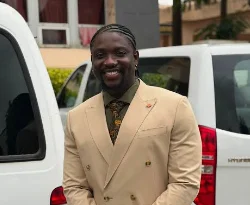
Few Nigerian public figures divide opinion like Martins Vincent Otse, known online as VeryDarkMan or VDM. He is a social commentator, activist and digital influencer, and he is the president of the Ratel Movement. His blunt style has made him famous, and it has also made him controversial. This post looks past the noise at the programs, projects and interventions he has led or driven, and at what they mean for individuals and industries.
1. The Martins Vincent Otse Initiative (MVOI)
The centrepiece of his social impact work is his NGO. VDM launched it in October 2024, focusing on public education reform, community development and clean water projects, among other social impact initiatives. The organisation runs a public financial tracker at mvoi4all.com and claims zero fees and 100% of funds going to projects.
The public response was immediate. The NGO raised over ₦35 million within its first 24 hours, and Don Jazzy gave ₦100 million. In a later update, VDM shared a screenshot showing that as of June 22, 2026, the NGO had raised ₦691.6 million in lifetime donations, of which ₦671.8 million had been deployed to projects. These are self-reported figures. For a young, crowd-funded NGO, the willingness to publish a running tracker is a transparency practice worth noting.
In July 2025 he also unveiled a new office space for the NGO, which he said would serve as the central hub for his charity projects and formal complaint handling.
2. Fighting Human Trafficking: The Côte d’Ivoire Intervention
This may be his most consequential intervention. In 2025, VDM drew national attention to young Nigerian girls trafficked to Côte d’Ivoire. He shared a video of himself in an Ivorian orphanage with more than ten girls and publicly pressed government agencies to act.
The results followed:
- A donation to NAPTIP. He donated ₦20 million to NAPTIP through the MVOI to help bring the trafficked children back to Nigeria and support their rehabilitation.
- Arrests. NAPTIP arrested two suspected masterminds of a Côte d’Ivoire trafficking syndicate, and the agency’s statement linked this to VDM’s intervention and his visit to its headquarters.
- Rescue and repatriation. 78 Nigerian victims, including underage girls and three babies, returned home after being rescued from Côte d’Ivoire, and Air Peace flew them back at no cost.
- Official recognition. At a NAPTIP meeting, the Chairman of the Board praised VDM’s advocacy and encouraged him to use his platform to inspire other young Nigerians to contribute positively to nation-building.
He did not stop at repatriation. He argued that “bringing them back is not the solution,” and that stopping the girls from going in the first place is. That is a prevention-focused view of the problem.
3. Freeing Inmates and Easing Hospital Bills
In December 2025, Burna Boy gifted VDM $100,000 (about ₦150 million) for prisoners and patients in need. The funds were to be split equally, with $50,000 paying fines for prisoners unable to secure release and the other $50,000 settling hospital bills.
VDM and Burna Boy then visited the Kirikiri Maximum Security Custodial Centre in Lagos to discuss releasing inmates who could not pay their fines. Reports noted that no prisoners could be freed on the spot, because the warden said proper protocols had to be followed. VDM said he planned to collect data on fined prisoners in all 36 states so the money could go round. The project shines a light on people jailed over small fines, which is a real and under-discussed problem in the justice system.
4. Rebuilding a Public School and Building a Clinic
Education is the NGO’s founding focus. In October 2026, VDM shared a detailed video of a school renovation project funded by the Burna Boy donation. According to the report, he first visited the school on March 7, 2026, found it dangerously dilapidated, and began perimeter fencing on April 25, 2026, after seeking approval from local community leaders. The project then grew to include a new classroom block, toilets, solar-powered street lights, a sports field, an administrative block, a laboratory and a community clinic.
The project drew questions from critics about how the funds were spent, and VDM responded by publishing the before-and-after documentation. That is how accountability should work in philanthropy: show the work and let people judge it.
5. Clean Water for Communities
The NGO has also funded boreholes. VDM shared a video showing two borehole projects funded by his NGO in a community in Ghana, and said similar projects were ongoing in Nigeria. The Ghana project drew mixed reactions, with many Nigerians arguing that similar needs exist at home. The criticism is fair, and it shows the public holds the NGO to a high standard.
6. Backing Young Talent
Beyond institutions, he has invested in individuals. After receiving a $50,000 gift, he announced plans to sponsor a young Nigerian inventor abroad, saying he was inspired by the boy’s rare talent and determination. Directing resources toward young innovators matters for Nigeria’s technology and engineering pipeline.
7. Consumer Protection and the Anti-Fraud Campaign
Before the NGO, VDM built his following through public callouts. He began his campaign by calling out the founder of Jennysglow. Supporters credit this work with pushing fraud, scams and misconduct into the public conversation and giving ordinary Nigerians a voice. He has also joined street-level advocacy, including a protest demanding an end to killings in Benue.
An Honest Look at the Controversies
A fair profile has to include the other side. His methods have drawn scrutiny:
- He has faced several lawsuits and arrests because of his activism, and some critics say he has become partial, especially toward people he has personal issues with.
- In 2025 the EFCC responded to a petition over the management of his NGO’s funds.
- He previously claimed that hackers stole over ₦180 million from the NGO’s account, an episode that raised questions about security and governance.
These points don’t erase the projects above, but they matter. The strongest case for his work, and for any NGO, is continued independent verification: audited accounts, named project partners and verifiable completion reports.
Conclusion
Whatever one thinks of his style, Martins Vincent Otse has turned online influence into tangible outputs. These include a trafficking rescue effort that involved a federal agency, school and clinic construction, inmate and hospital-bill relief, borehole projects and support for a young inventor. The lesson for other influencers is that attention can be converted into impact, provided it is matched by transparency and follow-through.